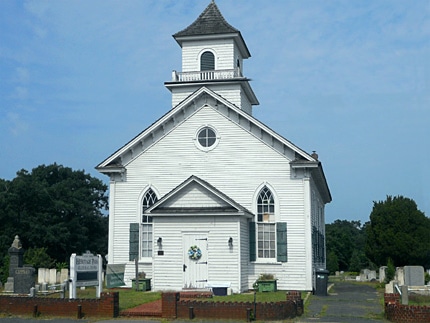
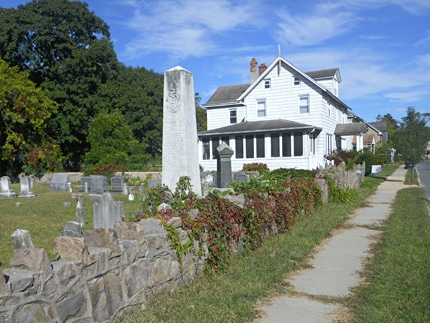
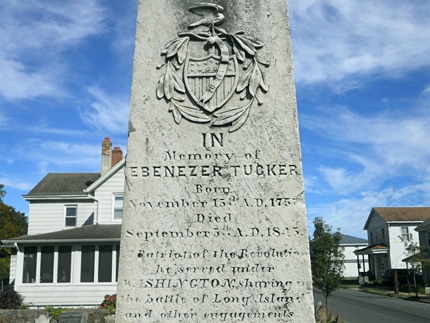
Old Manahawkin Baptist Church & Cemetery
Site of the Manahawkin Skirmish
Rte. 9 and North Lakeshore Dr.
Map / Directions to Manahawkin Skirmish Site
Now the home of the
Stafford Township Historical Society Heritage Cultural Center
Background
The last large-scale battle of the Revolutionary War took place at Yorktown, Virginia, and ended on October 19, 1781. The surrender of British General, Charles Cornwallis, at Yorktown brought about the decisive blow to the British army. However, the war did not officially end for another two years. For the most part, major fighting between the American and British armies was stopped during this period, as both sides waited for treaty negotiations to officially end the war.
However, for the citizens of New Jersey, the violence and bloodshed unfortunately continued during this period. Rather than fighting between large armies, there was mainly fighting between local residents and militia who supported American independence, and those who remained Loyal to Britain. Monmouth County was a particular hotspot for this form of partisan fighting. [1] Manahawkin, which is now part of Ocean County, was then part of Monmouth County, because Ocean County was not formed until 1850 from a portion of Monmouth County. [2]
Some of the Loyalist attacks in this area were conducted by men known as Pine Robbers. The name derived from the fact that they tended to operate and hide out in the large wilderness section of South Jersey known as the Pine Barrens. One of the most infamous of the Pine Robbers was Captain John Bacon. Bacon’s exploits in Monmouth County during this period continued right up until almost the end of the war. At the very end of 1781, two months after Yorktown, Bacon and a band of Loyalists came through Manahawkin on one of their raiding missions, resulting in a skirmish in the land around the Manahawkin Baptist Church.
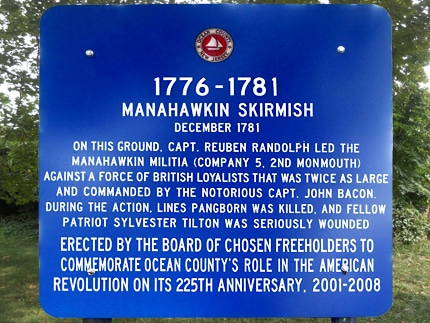
Manahawkin Skirmish
December 30-31, 1781 [3]
On December 30, 1781, word reached Manahawkin that Bacon and a band of raiders were moving through the area plundering, and would likely come through Manahawkin. Local militia assembled quickly at the tavern of militia captain Reuben Fitz Randolph, which was located about 200 yards south of the Baptist Church. They prepared to resist Bacon and his men if and when they came through Manahawkin.
As the night grew late and Bacon’s men did not appear, it seemed that the news of their approach may have been a false alarm. The militiamen went to sleep around two or three o’clock in the morning, but posted sentinels to keep watch during the night. Two sentinels were posted near the Baptist Church, and two closer to Randolph’s tavern.
Just before daylight on the morning of December 31, Bacon’s men came marching in from the north, from Barnegat Township. When the sentinels near the Baptist Church heard Bacon’s raiders approaching, they ran to the tavern to sound the alarm to alert their fellow militiamen.
Before the militiamen could properly organize, Bacon’s men opened fire on them, killing one – Lines Pangborn, and wounding another – Sylvester Tilton. There were about thirty or forty in Bacon’s raiding party, which was twice the militia’s strength. The outnumbered militiamen were forced to retreat. Bacon’s men continued on through Manahawkin, heading south towards West Creek.
Bacon would continue to raid and plunder in this area over the following year and a quarter. Ten months after the Manahawkin skirmish, Bacon was involved in what is known as the Long Beach Island Massacre. See the Long Beach Island page for the story.