
When South Jersey Said “No”: The Greenwich Tea Burning of 1774
Long before the United States became a nation, a small South Jersey community quietly—but fiercely—joined the growing chorus of resistance against British rule. While Boston’s Boston Tea Party remains the most famous act of colonial protest, December 22, 1774 brought a similar and equally symbolic act of defiance to the banks of the Cohansey River in Greenwich, Cumberland County.
The question on many Revolutionary War timelines is this: Did South Jersey Patriots burn tea in protest? The answer is a resounding yes, and here’s how it unfolded.
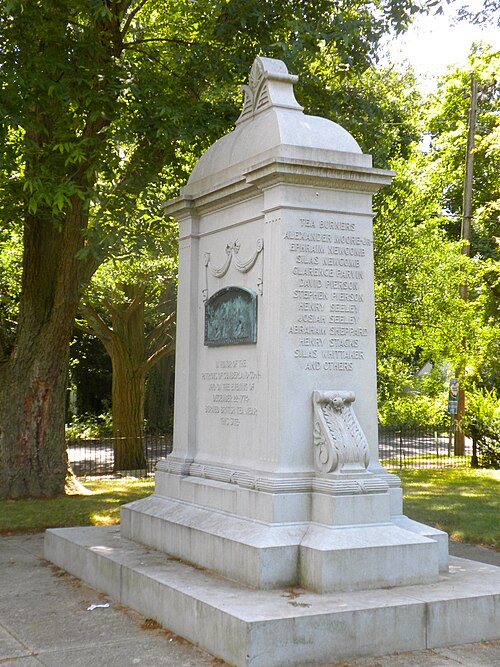
Greenwich Tea Burning Monument
Tea in the Cellar: More Than a Commodity
Under the Tea Act of 1773, Parliament granted the British East India Company a virtual monopoly on tea sales in the American colonies. Instead of calming tensions with lower prices, the Act ignited outrage. Colonists saw it as another example of taxation without representation.
Just over a year after the Boston Tea Party, New Jersey’s own patriots took action.
On that cold December night, a group of about forty local men, some disguised in the popular guise of Native American clothing (a tactic also used in Boston), seized a large quantity of British tea stored in the cellar of local resident Dan Bowen. Without hesitation, they carried the chests out and burned the tea in protest against what they saw as unjust taxation and interference in colonial affairs.
Why It Matters
This incident was not merely mimicry of Boston’s protest; it was part of a broader, organized wave of resistance that swept across the colonies in late 1774. From Salem to Charleston, communities opposed the Tea Act, and Greenwich was no exception.
Historians point out that:
- The Greenwich Tea Burning occurred months after the First Continental Congress adjourned in October 1774, showing that resistance was ongoing and intensifying.¹
- The act reinforced local unity and helped signal that even smaller, rural towns were unwilling to accept British economic control.²
- Unlike Boston’s well‑publicized event, South Jersey’s protest was less publicized at the time, but not less principled or bold.³
A Quiet Revolution with Loud Implications
Today, this event stands as one of South Jersey’s earliest Revolutionary moments. The men of Greenwich didn’t just burn tea, they took a stand that echoed beyond Cumberland County. Their protest illustrated a growing conviction: that self‑determination, community rights, and resistance to unfair laws were worth defending.
As we approach 250 years since the war for independence, remembering these local stories matters. They remind us that the Revolution wasn’t won solely in large cities or on famous battlefields, it was also shaped by small towns whose residents risked everything for their beliefs.
Sources & Further Reading
- Cumberland County Historical Commission — https://www.cumberlandcountynj.gov/greenwich-tea-burning
- Crossroads of the American Revolution — https://revolutionarynj.org/sites/greenwich-tea-burning-monument/
- Governor Richard Howell Society — https://govhowell.org/events/greenwich-tea-burning/
- Visit South Jersey — https://visitsouthjersey.com/directory/greenwich-tea-burning-monument/
- https://en.wikipedia.org/wiki/Greenwich_Tea_Party